INFORMATION
About the condition
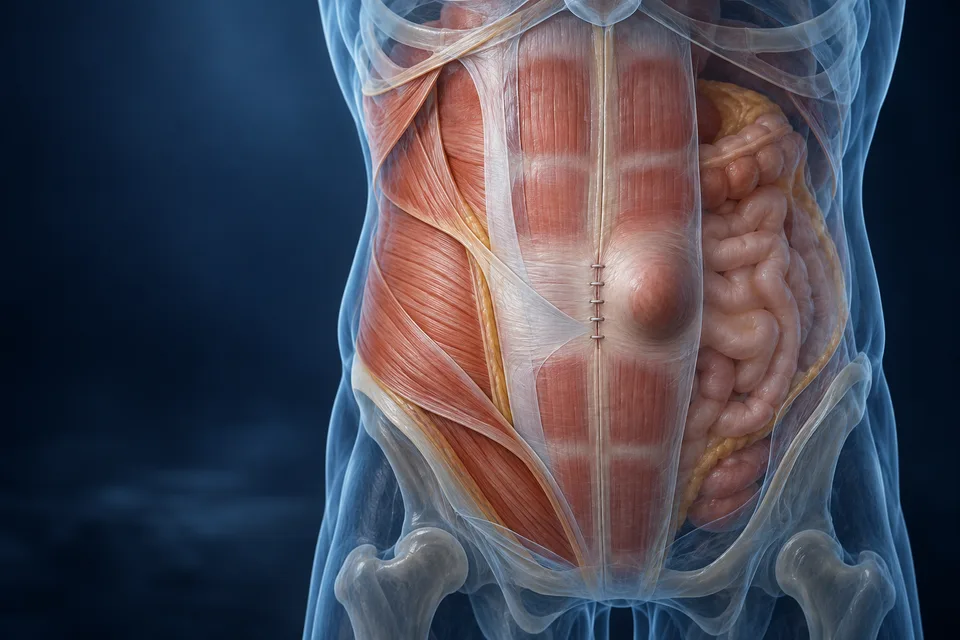
An incisional hernia develops at a previous surgical incision when the healed abdominal wall is weaker at that site. It may appear months or years after the original operation, whether open or laparoscopic, and tends to grow over time. Modern repair using newer meshes and minimally invasive techniques can treat even large or recurrent hernias.
INFORMATION
What is an incisional hernia?
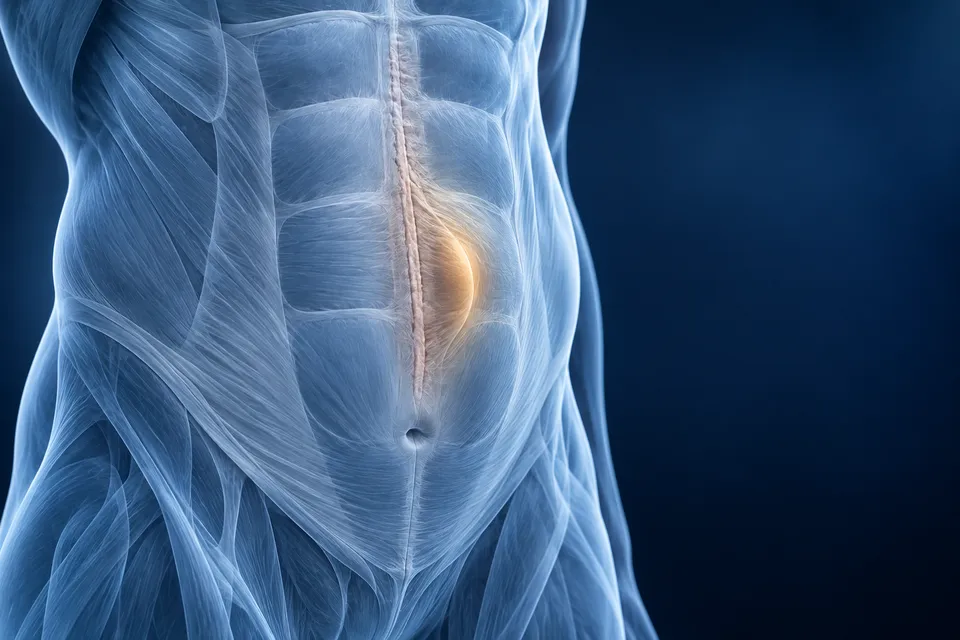
Every surgical incision in the abdominal wall heals with scar tissue, which is not as strong as the normal wall. When a gap develops there, abdominal contents protrude through it — this is an incisional hernia.
Its characteristics:
It can appear months or years after the original operation.
It can affect incisions from open surgery and, less commonly, laparoscopic port sites.
It ranges from a small defect to an extensive hernia containing a large amount of bowel outside the abdominal cavity.
Parastomal hernia — a particular type that develops around a stoma, such as a colostomy or ileostomy, and is treated using similar principles.
INFORMATION
Why does it occur?
Factors that increase the likelihood:
Related to the original surgery — healing complications, wound infection, emergency surgery or a large midline incision.
Related to the patient — excess body weight, smoking, diabetes, chronic cough or constipation, treatments affecting healing such as steroids, and older age.
Strain before complete healing — returning to strenuous physical activity too early after the original operation.
Understanding these factors has practical value: modifiable factors, such as weight, smoking and blood glucose control, can be improved before repair, also reducing the risk of recurrence.
Personalised CARE
The right treatment
starts with you.
Your investigations, history and needs guide the next step. Discuss the available options with your doctor.
Talk to the doctorATTENTION TO THE SYMPTOMS
How can I recognise it? Symptoms
A bulge or swelling on or beside the scar, more noticeable when standing, coughing or straining.
A feeling of heaviness, tightness or pain around the incision.
Gradual increase in size over time.
With large hernias: difficulty moving or dressing, changes in abdominal contour and skin irritation.
Occasional bowel symptoms, such as cramping pain or constipation, when bowel enters the hernia sac.
INFORMATION
When is it an emergency? Strangulation and obstruction
Like any hernia, an incisional hernia can become strangulated: its contents become trapped and lose their blood supply, or the bowel becomes obstructed. Seek immediate medical assessment if:
the bulge suddenly becomes hard, very painful and cannot be pushed back,
severe abdominal pain, nausea, vomiting or inability to pass wind or stool develops,
the skin over the hernia becomes red or changes colour.
THE PROCEDURE
How is the evaluation done? Step by step
Medical history — The original operation and healing process, when the hernia appeared, symptoms and other medical conditions.
Clinical examination — Assessment of the location, size, reducibility and overall quality of the abdominal wall.
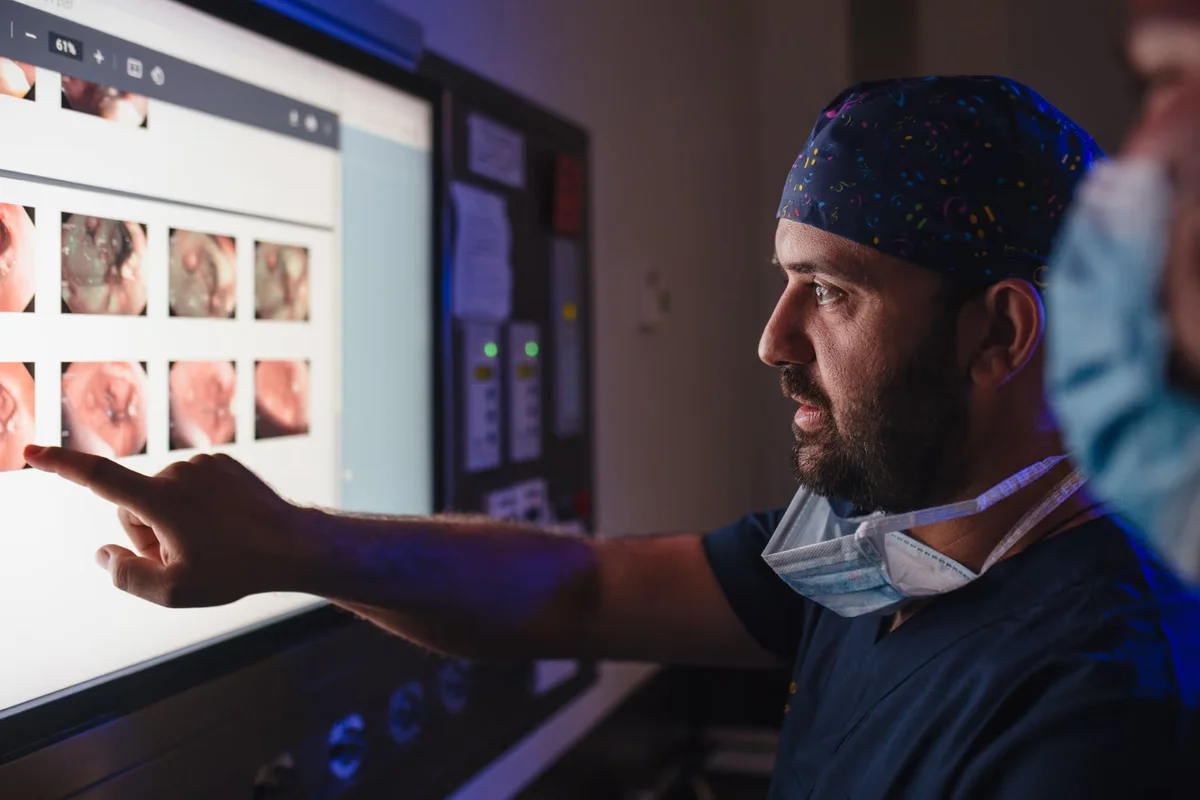
Imaging — CT has a central role in incisional hernia assessment: it accurately shows the size of the defect or multiple defects, the contents of the sac and the condition of the muscles — essential information for planning.
Optimisation before surgery — Where needed, weight loss, stopping smoking and blood glucose control, within a realistic timeframe.
Treatment planning — Selecting the technique and mesh according to the anatomy, history and patient’s goals.
TREATMENT OPTIONS
Treatment options
Why use mesh?
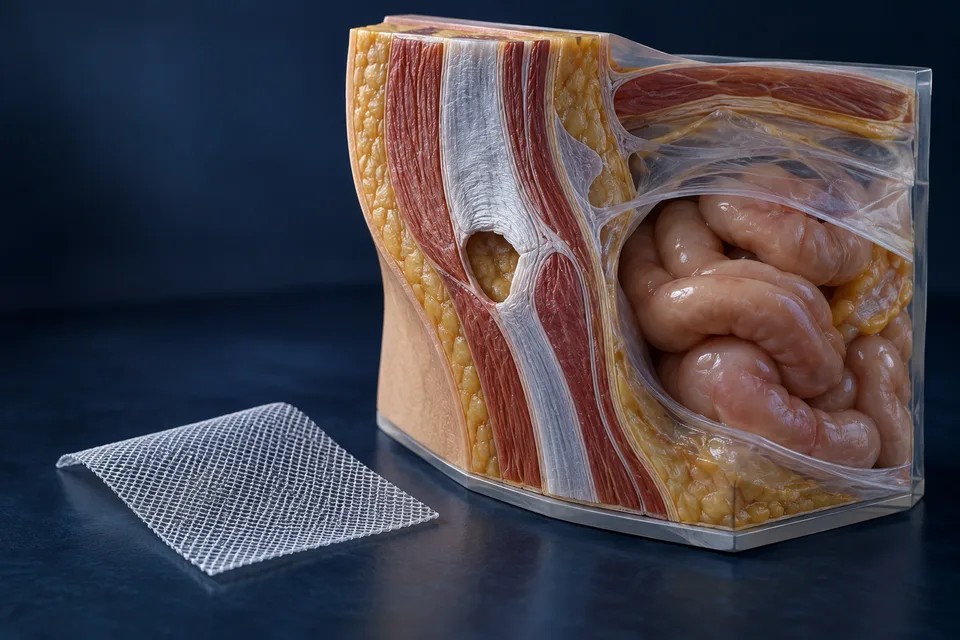
In an incisional hernia, simply stitching the already weakened tissue carries a high risk of recurrence. In the vast majority of cases, the wall is therefore reinforced with a specialist mesh. We use modern meshes designed to reduce the risk of adhesions.
Laparoscopic / robotic repair
In suitable cases, even with large hernias, repair is minimally invasive through small openings away from the old scar. This approach is generally associated with a lower risk of wound infection, particularly important after previous healing complications, less pain and earlier mobilisation.
Open repair / complex abdominal wall reconstruction
Very large or complex hernias may require open abdominal wall reconstruction using specialist techniques to restore the midline.
Parastomal hernia
Repair around a stoma has specific technical considerations and is planned individually.
INFORMATION
Recurrence: why it happens and how it is prevented
A reasonable question for anyone with an incisional hernia, particularly after a previous repair, is whether it will happen again. The honest answer is that recurrence is possible after any hernia repair, but its likelihood is substantially reduced when:
repair uses appropriately sized and positioned mesh rather than stitches alone,
complete imaging with CT is obtained beforehand to address all defects, not just the visible one,
modifiable factors such as weight, smoking and blood glucose are optimised before surgery,
postoperative guidance on a gradual return to activity is followed.
For recurrent hernias, reassessment by a team with relevant experience is particularly important — each subsequent repair is technically more demanding.
INFORMATION
What to expect at your first appointment
Step 1 — Your surgical history: The original operation, any complications, and when and how the hernia appeared.
Step 2 — Clinical examination and imaging review: If you already have a CT scan, we review it together; otherwise, we arrange one.
Step 3 — Discussing the options: Minimally invasive or open reconstruction, mesh type, realistic expectations and the potential benefits in everyday life.
Step 4 — The plan: Any optimisation needed before surgery, preoperative assessment and a timetable.