INFORMATION
What is a femoral hernia?
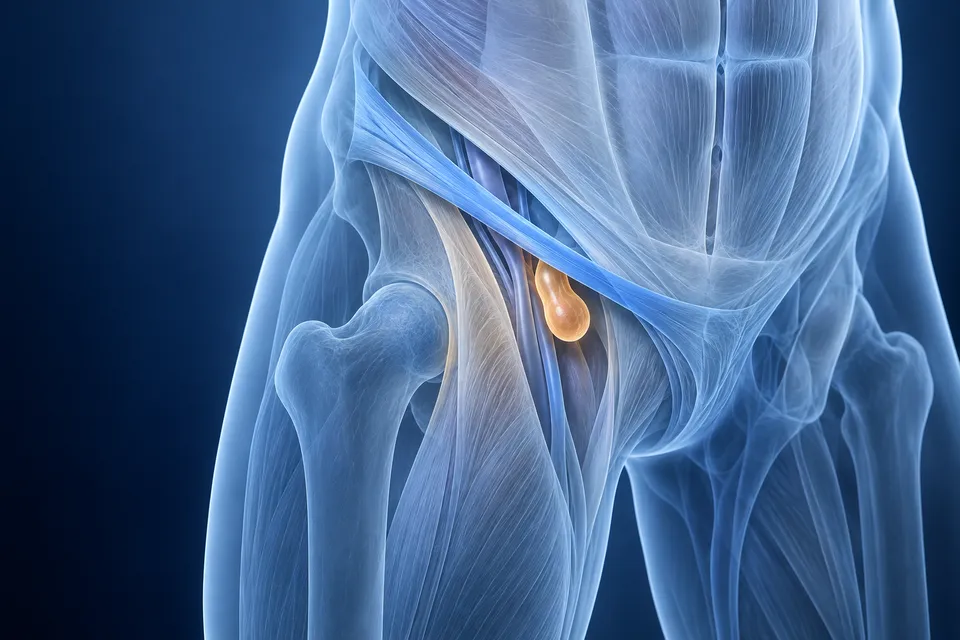
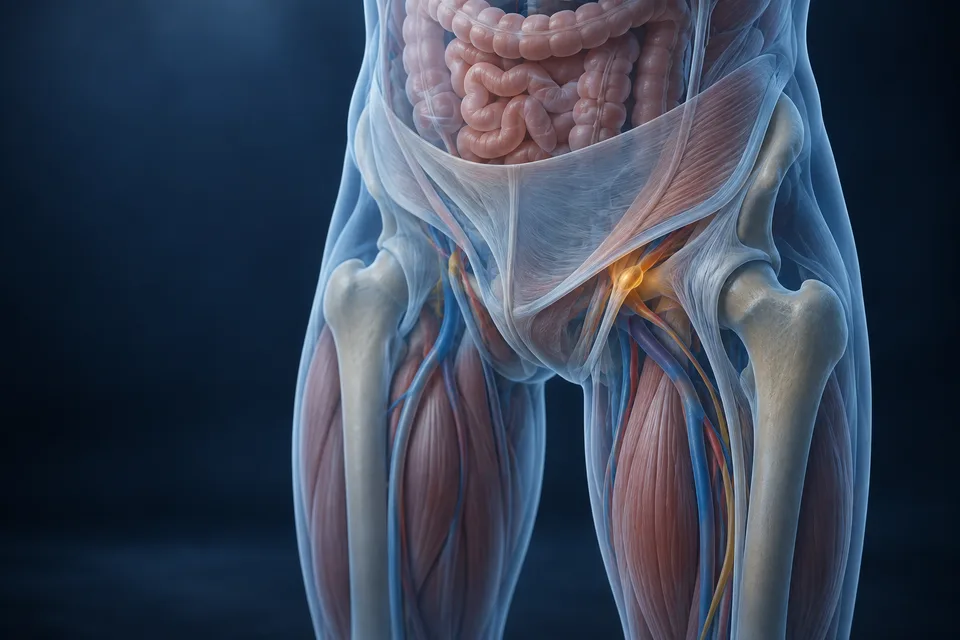
Below the inguinal ligament — the line separating the abdomen from the thigh — the femoral vessels pass towards the leg through a narrow passage, the femoral canal. When abdominal contents, such as fat or bowel, protrude through this canal, a femoral hernia forms: a bulge at the top of the thigh, slightly lower and further out than a typical inguinal hernia.
Femoral hernias are less common than inguinal hernias and mainly affect women. Their defining feature is their anatomy: the opening of the femoral canal is narrow and surrounded by rigid structures, so contents can easily become trapped. Femoral hernias therefore carry the highest risk of strangulation among abdominal wall hernias. Unlike some other hernias, they are generally not managed by watchful waiting: repair is planned when the diagnosis is made.
Femoral or inguinal hernia?
The two types occur close together and are often confused, but distinguishing them matters in practice:
Distinguishing them clinically is not always easy, particularly with small hernias or excess body weight. Every groin swelling therefore needs surgical assessment.
Read more about inguinal hernia: → Read more]
Symptoms
A bulge at the top of the thigh or lower groin — often small and difficult to see, particularly when sitting.
Discomfort or pain when standing, walking or straining.
In several cases, a femoral hernia causes almost no symptoms until a complication, strangulation, produces sudden pain and a hard, tender bulge.
This silent behaviour is another reason to plan femoral hernia repair rather than wait.
INFORMATION
Who is affected?
Women — substantially more common because of pelvic anatomy, particularly after pregnancies or significant weight loss.
Older people — weakening tissues increase its frequency.
People with chronically increased abdominal pressure — chronic cough, constipation or heavy physical work.
It also occurs in men, less commonly.
INFORMATION
Why is watchful waiting generally unsuitable? Strangulation
Some other small, entirely symptom-free hernias may be monitored after assessment. This generally does not apply to femoral hernias: their narrow, rigid opening makes trapping of the contents and loss of blood supply significantly more likely, and a complication may be the first sign.
Seek immediate medical assessment if:
a hard, painful bulge suddenly appears at the top of the thigh,
it is accompanied by severe abdominal pain, nausea, vomiting or inability to pass wind or stool.
A strangulated femoral hernia requires emergency surgery. Planned repair before this happens is a simpler, safer operation with time for preparation.

Personalised CARE
The right treatment
starts with you.
Your investigations, history and needs guide the next step. Discuss the available options with your doctor.
Talk to the doctorTHE PROCEDURE
How is the evaluation done? Step by step
Medical history — Symptoms, duration, pregnancies, weight changes and factors increasing abdominal pressure.
Clinical examination — Standing and lying down, with a cough test and careful assessment of the bulge’s position relative to the inguinal ligament.
Ultrasound — Often necessary to confirm the diagnosis and distinguish a femoral hernia from an inguinal hernia, enlarged lymph node, varicose vein or lipoma.
CT or MRI, less commonly — For uncertain or complex cases.
Treatment planning — Scheduling repair and selecting the technique.
TREATMENT OPTIONS
Treatment options
The foundation: mesh repair
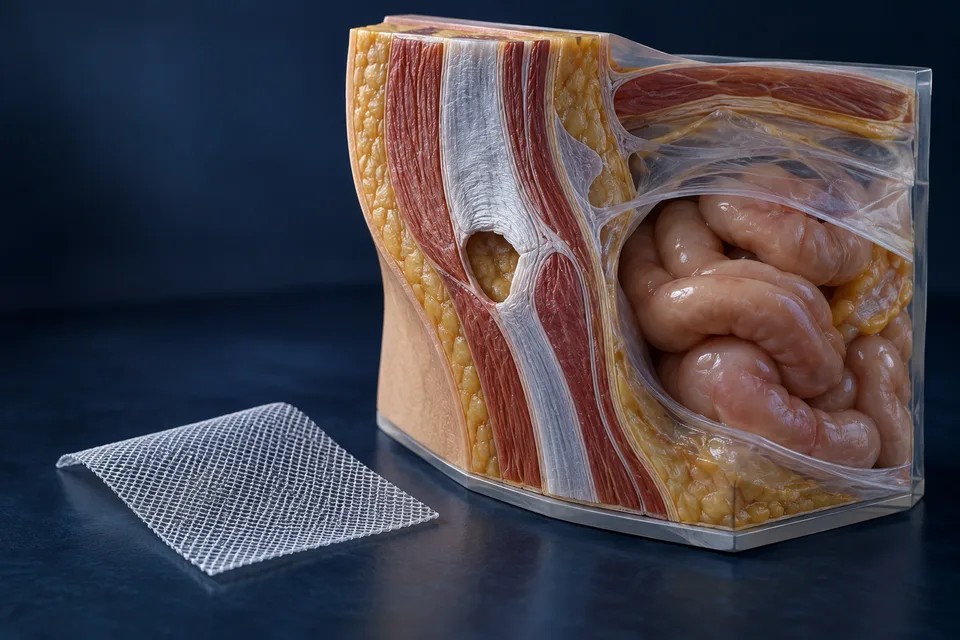
The femoral canal defect is closed and the area reinforced with specialist mesh to minimise recurrence.
Minimally invasive approach — laparoscopic / robotic
Preperitoneal mesh placement through small openings offers a particular advantage for femoral hernias: the mesh covers all potential hernia sites in the area from within, including the femoral canal and inguinal canal, addressing a coexisting or potential future inguinal hernia in the same operation. It is associated with less postoperative pain and early mobilisation.
Open repair
Suitable in selected cases, and the preferred approach for an emergency strangulated hernia when the viability of its contents may need assessment.
The technique is always selected individually.
INFORMATION
What to expect at your first appointment
Step 1 — Your history: When the bulge appeared, how it behaves and what makes it worse.
Step 2 — Clinical examination and ultrasound: Confirming a femoral hernia rather than another cause of swelling.
Step 3 — Discussion: Why femoral hernia repair is planned without watchful waiting, and which technique suits your case.
Step 4 — The plan: Preoperative assessment and scheduling the repair.